The Use of Aversives: An Introduction
February 25, 2010
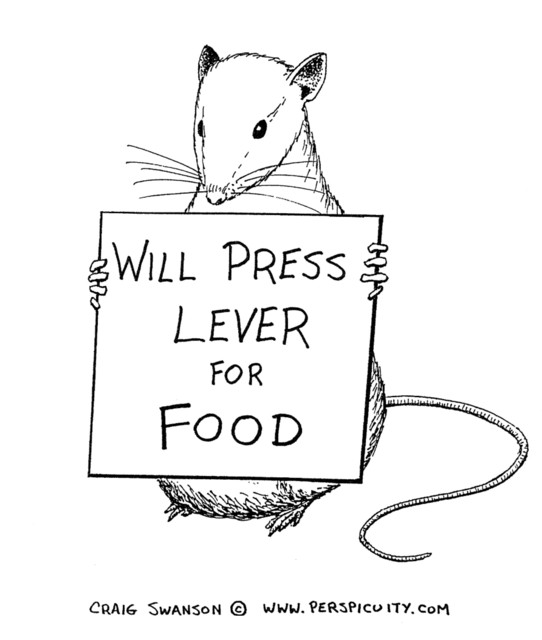 What are aversives? According to the Merriam-Webster Dictionary, aversive is an adjective meaning, “tending to avoid or causing avoidance of a noxious or punishing stimulus <behavior modification by aversive stimulation>.” When we mention aversives as a noun, we are referring to tools trainers use that create the noxious or punishing stimulus referred to in the adjective’s definition. Dogs behave in desired ways because they are avoiding the punishing stimulus.
Which begs another question: What is punishment? In psychology, punishment is the reduction of a behavior via a stimulus which is applied (“positive punishment”) or removed (“negative punishment”). Making a disobedient student stay in for recess is an example of negative punishment; issuing extra chores or spanking are examples of positive punishment. The definition requires that punishment is only determined after the fact by the reduction in behavior; if the offending behavior of the subject does not decrease then it is not considered punishment.
If a punishment is not serving its intended purpose but continues to be used in the same manner, it then crosses the line from punishment into abuse. This is easy to see if the chosen method of punishment is spanking but is less clear to the layperson when discussing the training methods used on dogs.
With all of the research done about learning theory and operant and classical conditioning, why do people still feel the need to use punitive methods when training dogs? Friedrich Nietzsche may have said it best: “…because the desire to punish (and thereby subordinate, coerce, transform) other persons is so deeply rooted in human nature” (Nietzsche 1887).
A simple rule applies: if you wouldn’t want it done to you, don’t do it to your dog.
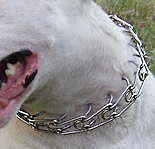
The Prong Collar
There’s much controversy around the use of prong collars in dog training. Trainers who use them swear by them; other trainers and behaviorists are working tirelessly around the country to outlaw their use.
People who use them insist they aren’t harmful to the dogs.
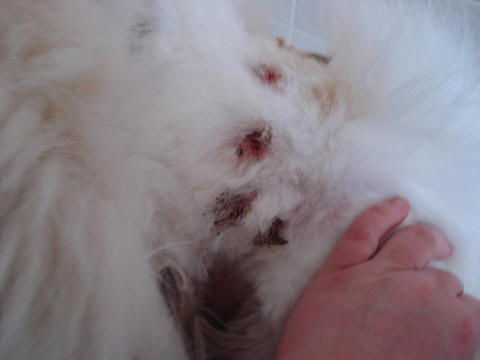
Really?
Prong collars appear to work almost miraculously – put one on your dog and there’s a very good chance he’ll stop pulling on his leash almost immediately. This isn’t because the prongs rest on sensitive pressure points that release calming chemicals in the dog’s brain, instantly making them willing to walk peacefully beside you. It’s plain and simple – they stop pulling because IT HURTS.
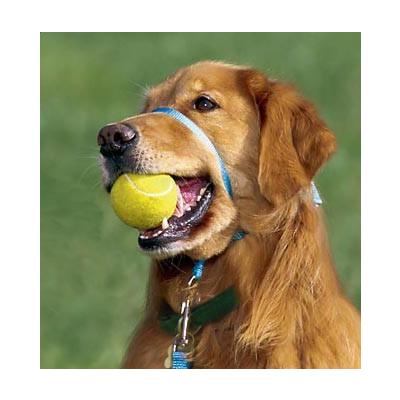
The Gentle Leader
The Gentle Leader, also called a head collar, is a very effective tool for dogs that pull on leash. It works by turning the dog around when he pulls. The dog learns that if he pulls, he will get further away from the thing he’s trying to get closer to; if he wants to continue making forward progress, he needs to walk without pulling.
There’s no great mystery to this. It doesn’t involve pressure points on the dog’s face as some less-informed trainers claim. It just turns the dog around. Does it take time to get your dog used to having something on his face? Yes, absolutely. Treats or toys work wonders to distract him from the Gentle Leader; get him moving on his walk and he will quickly forget about the harness.
Are Gentle Leaders for every dog? Almost. Any dog can use a Gentle Leader. Dogs with shorter snouts might have problems, such as pugs. I also never use one on a puggle or beagle under 1 year of age because they are very susceptible to cherry eye during this time and I’ve been told by a doggie ophthalmologist that the Gentle Leader may aggravate a cherry eye. But after they’re a year to 18 months old, go for it.
If you don’t like the Gentle Leader or your dog isn’t suited for one, try the…
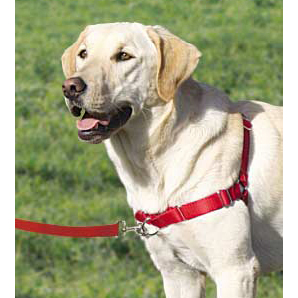
Easy-Walk Harness
This works on the same theory as the Gentle Leader – the leash attaches to the front of the harness right in the middle of the dog’s chest. If they pull against it, they are turned around. Again, they don’t get where they want to go if they insist on pulling.
Don’t confuse the Easy-Walk Harness with harnesses that have the leash attachment on the back of the dog. These harnesses actually encourage pulling due to the opposition reflex. It’s a naturally-occurring reflex that causes humans and dogs to pull or push against that which is pulling or pushing against us. Sled dogs use harnesses in training in order to build drive; you don’t need to build drive in Fido when you’re trying to walk him around the block!
Scientifically Speaking…
Besides the infliction of pain, there are other reasons for not using a prong collar.
First, it doesn’t teach the dog not to pull on his leash unless he’s wearing the prong collar. It doesn’t teach him the behavior you DO want. He learns to walk a certain way to avoid the pain and discomfort of the prongs, but if the prongs aren’t there, there is no learned behavior for Fido to exhibit. The Gentle Leader and the Easy-Walk Harness teach your dog that in order to get where he wants to go he must walk in a certain way – it teaches him what TO DO and it inherently rewards him for his good behavior
Second, they can be harmful to the bond you are trying to build with your dog. Think of it in terms of children – if your parents repeatedly used something that hurt you, seemingly at their own will and mercy, would you trust them? No, you would be afraid of them, anxiously anticipating when the device was going to surface again and trying your best to appease them so they wouldn’t hurt you so badly this time. What do you think your dog is doing when you pull out the collar and he sits with his ears flattened against his head?
Third, prong collars can actually train your dog to be aggressive! Think I’m kidding? Here’s how that works….you take your dog for a walk on a prong collar, issuing “small” leash corrections when he does something you don’t like. Along comes another dog, who your dog would like to greet in a very friendly and canine-appropriate way…sniffing the other dog’s nether regions. You don’t like this behavior, so you jerk on the leash and make him continue to walk along with you. After a few days of this, your dog starts to realize that when another dog comes around, you jerk on his leash and hurt him. He now wants that other dog to stay away, so he starts demonstrating behaviors designed to tell the other dog just that – “Go away! My lady is crazy! She’s going to hurt me if you come any closer! GO AWAY!!” To you, this looks and sounds like leash aggression, so once again you jerk on the leash and try to get him to behave. He learns to stop barking, but he is still very anxious about the other dog coming near. Your dog is now faced with a “fight or flight” decision. He’s tried everything he knows to prevent the dog from coming near, but the dog continues his approach. Your dog can’t flee because he’s got this collar on that won’t let him move one inch away from you, so he has no choice but to fight, and as soon as that other dog is in striking distance, that’s exactly what happens. Congratulations, you now have a leash aggressive dog.
Remember my simple rule? Would YOU wear a prong collar and allow someone to lead you around by a leash? Why subject your dog to this when there are alternative methods – more humane methods and more reliable methods – for teaching your dog not to pull on his leash?
References
Nietzsche, Friedrich, 1887, On the Genealogy of Morals, tr. Walter Kaufmann, New York: Vintage, 1969.
The Importance of Play
February 14, 2010
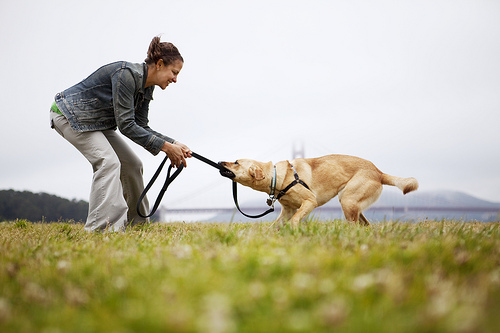 You’ve probably heard the expression “a tired dog is a well-behaved dog.” It’s been around for a while, and it’s become increasingly popular since one particular “trainer” on television advocates the use of a treadmill for dogs who can’t be given regular exercise. But physical exercise isn’t the only way to tire a dog out. Mental stimulation (ie, training) is incredibly tiring to dogs, as are fun dog sports like agility, discing, lure coursing, etc. But another great way to tire your dog out is to PLAY with him!
Categories of Play
Dogs have different play styles, so not every dog can play with every other dog. Some just aren’t compatible players, and that’s OK. But when playing with humans, there are several broad categories of games that most dogs will find enjoyable.
- Object play – play using a stick, ball, toy, Frisbee
- Mind games – best for dogs on kennel or crate rest or whose movement is otherwise limited.
- Chase – games that involve you and your dog chasing after each other.
- Physical contact games – generally not recommended and far more common with men than women, these are rough-housing type games – play wrestling, etc.
Benefits of Play
There are many benefits of playing with dogs, not the least of which include:
- A fun form of exercise (hide & seek; chase);
- A reward for training (a quick game of tug as a reward for a solid sit/stay);
- A reinforcer for behavior modification programs (play through a thunderstorm to help avoid/prevent/modify storm anxiety)
The Controversy of “Tug”
There are many misconceptions about tug, especially in pop culture dog training. Currently popular trainers will say that tug encourages your dog to be “dominant” over you; that you should always win at tug because the winner is the leader of the pack; that tug encourages aggression. None of these are correct or true.
Tug is actually an excellent physical activity for dogs involving the full body and its musculoskeletal system. It’s physically exerting for them, and it can be done in smaller spaces such as apartments, or on rainy days when you and Fido don’t want to venture outdoors for extended periods of time. It’s a great game to incorporate into training and behavior modification. It’s a good alternative for people who want to roughhouse with their dog. And it’s a safe way to redirect the teeth of a dog who tends to get “mouthy” when playing.
There are a few simple rules that should be observed when playing tug to make sure that you are not reinforcing any negative behavior inadvertently. These include:
- You control the good stuff. This means you start and stop the game.
- No grabbing. Don’t allow play to begin if your dog grabs for the toy. Teach him to wait for a cue for the game to start as well as to release the toy on command.
- Tug using side-to-side motion only, as up-and-down movement can cause injury to the spine and teeth. Also make sure the force you use is in proportion to the dog’s size and weight.
- Use time outs if needed. If Fido becomes mouthy and can’t be redirected to the toy, stop play immediately. Do not reinforce mouthiness. The same goes for jumping up in order to reach the toy or trying to grab it out of your hand.
Go Play!
Since most of our country is going through a particularly harsh winter, a lot of dogs and their people are probably suffering from a little bit of cabin fever right about now. Dogs need to burn off a ton of energy and humans want to stay warm and dry as much as possible. So go grab a long rope toy and start playing tug with your dog! You’ll both feel better for it!
Reference
Pat, Miller. Play With Your Dog. Wenatchee, Wash: Dogwise Pub., 2008.
Barking
February 1, 2010
 Dogs bark for a number of reasons, but excessive barking can also be a signal that your dog is under a great deal of stress.
Barking is Good!
Typically excitement barking is a good thing – it means your dog is excited, happy, looking forward to something. Imagine if you were over the moon happy about something and weren’t allowed to smile, tell a friend about what’s going on, clap your hands quietly, do a little dance in your cube at work? Barking is part of a dog’s normal expressions of happiness, just like jumping, spinning, running around, wagging the tail so hard the whole body wiggles. These are all good things, and necessary in order to burn off the adrenaline that is in the dog’s body.
There are five situations where excitement barking is common:
- When you come home;
- When visitors arrive;
- In the car;
- When they see other dogs;
- As a result of chronic stress.
In the first four instances, there are ways of working with your dog to reduce the severity and incidence of the barking while still allowing him the opportunity to express himself.
Barking from Chronic Stress
Barking resulting from chronic stress however requires that the dog’s stress level be brought down before you can begin to work with the immediate trigger of the behavior.
Owners can cause chronic stress in their dogs and not even realize it. Seemingly pleasurable activities, such as playing fetch, bicycling or jogging together, or having playdates with other dogs can all create stress when done in excess.
How do these normal doggie activities create chronic stress? Well, as your doctor has probably once told you, everything in moderation. Stress causes hormones and other chemicals to be released in the body. After a stressful event, the body needs to recover – its chemical balance needs to return to normal.
Let’s say you have one of those dogs that just obsesses over tennis balls. We all know one, right? Your dog can’t put the tennis ball down, ever, so you take him out multiple times a day for extensive games of fetch hoping he’ll get it out of his system once and for all, and at the very least you know he’s having a blast because he loves that ball, right? The dog gets super excited during that first outing and chemicals distribute throughout his body. Before they are fully processed by his systems, you’re back out for fetch game 2…and so on throughout the day. The hormones never get a chance to completely leave his body, so they continue to build up with each game of fetch. Eventually he’s running around with adrenaline levels of a dog in the midst of a game of fetch but he’s only lying on the couch. Or trying to lie on the couch – his adrenaline levels are probably too high to actually allow him to rest.
There are also environmental causes for stress in dogs that their owners may not be aware of. They include:
- Too little sleep;
- Too little food and/or water;
- Isolation from owner and/or other dogs;
- Not having the opportunity to go to the bathroom when needed;
- Too much noise or activity in the house;
- Too much time spent in crates or kennels; and
- Too many perceived threats such as strangers, storms, other unfriendly dogs.
If you have an excessive barker in your home and think any of these may be the cause, you must first eliminate the stressor before addressing the behavior.
Reference
Rugaas, Turid. Barking: The Sound of a Language. Wenatchee, WA: Dogwise, 2008.
What is Positive Reinforcement?
January 15, 2010
 Positive Reinforcement refers to a training philosophy where the goal is to enhance the human-animal bond through enrichment activities and reward-based training sessions. It involves the use of classical and operant conditioning, basic learning theory, and a lot of fun thrown in for good measure!
But positive reinforcement is not new in the dog training world, it’s just not been popular, much to the amazement of professional trainers and behaviorists who have seen so much success with it.
Here’s a quick overview about positive reinforcement, what it is, and what it isn’t.
Consequences
Training is, essentially, about consequences. Dogs will always do what works for them and they learn what works through trial and error. The more a behavior yields the results they are hoping for, the more they will demonstrate that behavior. This is very simple cause and effect.
In the training world, there are 4 basic types of consequences:
- Positive reinforcement: good things start. Dogs want this to happen.
- Negative punishment: good things stop. Dogs try to avoid this from happening.
- Positive punishment: bad things start. Dogs try to avoid this from happening.
- Negative reinforcement: bad things stop. Dogs want this to happen, but there are other consequences for the trainer’s actions.
For example, when teaching a dog to sit, it is common to issue them a treat once their butt hits the ground. They learn that putting their butts on the ground makes good things happen, ie, they receive a treat. This is an example of positive reinforcement.
If you’re playing with your dog and he accidentally bites you, a loud “ouch” and immediately stopping the play teaches him that biting is not a desirable behavior. Even though it was an accident on his part, it led to a good thing ending (the play stopped) so he will make sure if he wants to continue to play that he doesn’t bite.
These are the two techniques that trainers committed to positive reinforcement will use – the starting and stopping of good things to motivate the dog to behave in a desired manner.
Other trainers – those without a foundation in behavior and learning theory – rely on the next two techniques more than the first two. They teach the dog to start and stop bad things through their behavior.
Positive punishment is pretty simple – basic punishment of undesirable behaviors. This might be spanking a dog, rubbing his nose in an accident in the house, shocking him with an electronic collar, jerking his leash…the list is endless.
An example of negative reinforcement is the use of prong collars. Despite what some trainers will tell you, prong collars are uncomfortable for dogs. Combining them with leash “corrections” can be incredibly painful. Using a prong collar to teach a dog to walk nicely really only teaches them how to walk to avoid the pain and discomfort of the prongs. The dog wants the bad thing – pain and discomfort – to stop, so he adjusts his walking behavior until the pain is at a more tolerable level.
We know that this particular technique doesn’t work however, for a very simple reason. It’s doesn’t teach the dog what behavior you WANT, it only distracts him into walking to avoid pain. If you try to walk him on a standard collar and leash, his pulling behavior will resume.
Reinforcers
Most people assume that positive reinforcement only uses food to motivate the dog. This is not the case at all; anything that a dog derives pleasure from can be used as a reinforcer in training. This might include:
- Food
- Play with other dogs
- Attention from people – cuddling, affection, etc
- Play with people – tug, chase, fetch, etc
Some people say their dog isn’t food motivated, but ALL dogs are motivated by food – they do get hungry after all! Sometimes the case is simply that the people haven’t found the right treat to motivate the dog to perform the desired behavior. When all else fails though, a dog’s daily allotment of food/kibble can be issued bit by bit as training rewards and you can train your dog through an entire meal!
Reference
Donaldson, Jean. The Culture Clash. 2nd ed. Berkeley: James & Kenneth, 2005.


 Puggles & Pitties
